Ionic Compounds
Ionic Compounds
Formation of Ionic Bonds
- Ionic bonds have in the solid state have a giant ionic lattice structure held together by ionic bonding
- Ionic bonding is the electrostatic forces of attraction between oppositely charged ions in an ionic compound
- Electrons are transferred from metal atoms to non-metal atoms to form ions that come together in a solid ionic compound.
- The atom that transferred the electron(s) gets positive charge(s) and becomes a cation
- The atom that gained the electron(s) get negative charge(s) and becomes an anion
- Oppositely charged ions attract each other, forming a regular 3-dimensional giant ionic lattice
- Each ion in the crystal lattice is attracted equally to several surrounding ions of opposite charge. This makes ionic bonding a non-directional bonding.
- Explaining Formula "each Na atom has one valance electron. To attain noble gas electronic configuration. each Na atom loses its valence electron to form a Na+ cation. Each O atom has six valance electrons. to attain noble gas electronic configuration, each O atom gains two electrons from two Na atoms to form an O2- anion. In the resultant giant ionic lattice formed, the ratio of the Na+ : O2- is 2:1 such that the lattice is electrically neutral overall. Therefore, the formula is Na20. "
Physical Properties of ionic bonding
- High melting and boiling points
- Ionic compounds have a giant ionic lattice. In melting, large amounts of energy is supplied to overcome the strong electrostatic forces of attraction between the oppositely charged ions to break the giant ionic lattice to form free ions
- Soluble in water
- conducts electricity in molten and aqueous state
- Ionic compounds do not conduct electricity in the solid state as the ions are fixed in position and are not free to move. In molten and aqueous solutions, the ionic lattice is broken down and the ions are mobile and are free to move. The ions are free to move and flow towards the oppositely charge electrodes and act as mobile charge carriers, carrying a current.
- hard, rigid and brittle
- In an ionic lattice, oppositely charged ions are held in fixed positions throughout the crystal lattice by strong electrostatic force of attraction. Moving the ions out of position requires large amounts of energy to break these bonds. Ionic lattices are therefore quite hard and rigid. However, if enough pressure (e.g. by cutting or knocking) is applied, ions of like charges are brought next to each other and the repulsive forces crack the salt suddenly. Repulsion between ions of like charges will cause the lattice to shatter apart. Ionic lattices are therefore said to be brittle.
Strength of ionic bonding #smtp
The strength of ionic bonding is determined by the charge of the ions, and their radii. The higher the charge and the smaller the radii of the ions, the stronger the ionic bonding.
- Effect of ionic charge (q): The greater the charge of the ions, the stronger the ionic bonds.
- Effect of ionic size (r): The bigger the ions, the greater the sum of the ionic radii, and the weaker the ionic bonds.
Solubility in water #smtp

When an ionic salt dissolves, each ion on the crystal's surface attracts the oppositely charged poles of the polar water molecules and the ions become hydrated (or solvated if solvent is another polar solvent). This hydration process releases energy. The ionic crystal structure breaks down and the solid dissolves.
| Term | Name | Meaning | Sign |
|---|---|---|---|
| Enthalpy of Solution | The total energy change of the dissolving process. | Can be or | |
| Lattice Energy (Broken) | The energy required to separate the ions from their solid crystal lattice. | Endothermic (+) | |
| Enthalpy of Hydration | The energy released when gaseous ions are surrounded by water molecules. | Exothermic (-) |
Dot-and-Cross Diagrams
Draw both ions separately and label the number of each ion in one ionic compound. Valence electrons in the cation, if all are given to the anion, should not be drawn; i.e. don't draw inner core electrons if all outer electrons are removed
Examples
| Compound | Dot-and-Cross Diagram |
|---|---|
| Drawing 2026-04-18 18.34.01.excalidraw | |
| Drawing 2026-04-18 18.39.52.excalidraw |
Metals
Metals in the solid state have a giant metallic lattice structure, held together by metallic bonding, which is the electrostatic force of attraction between metallic ions and the delocalised ions in the metallic lattice
Strength of metallic bonds
the strength of the metallic bond is determined by
- Number of delocalised valence electrons in the structure.
- The larger the number of valence electrons contributed per atom, the greater the number of delocalised electrons and the stronger the metallic bonding.
- Charge and radius of the metal cation.
- The higher the charge and the smaller the radius of the metal cation, i.e. the higher the charge density, the greater electrostatic force of attraction between the cations and the sea of delocalised electrons.
Description of metallic bonds
The structure of Calcium Metal is a giant metallic lattice containing an array of ions, with the valence electrons of calcium removed and free to move throughout the lattice. Metallic bonding exists between the resultant and the sea of delocalised valence electrons
Labelled Diagram
Drawing 2026-09-14 23.16.02.excalidraw
Physical properties of metals
- high melting and boiling points
- Most metals are solids with moderately high melting points and much higher boiling points. Metals have a giant metallic lattice structure which consists of a lattice of metals cations with a sea of delocalised electrons and the electrostatic forces of attraction between the cations and the delocalised electrons constitute the metallic bond. Melting and boiling points of metals are relatively high because a large amount of energy is required to overcome the relatively strong electrostatic forces of attraction between the cations and delocalised electrons.
- conducts electricity
- Metals are good electrical conductors because the delocalised electrons which act as mobile charge carriers are free to move about in the solid structure.
- good conductor of heat
- Metals are good heat conductors because they have mobile charge carriers The delocalized electrons in the metal disperse the heat quickly from a region of higher temperature to a region of lower temperature. The more energetic electrons collide with and speed up the slower, less energetic electrons, thereby allowing for good thermal conductivity
- malleable (can be easily beaten and flattened into sheets) and ductile (can be easily pulled into wires)
In a metallic structure, the metal ions are held in an orderly array.
- When an external force (e.g. hammering) is applied to the metal, the layers of the metal ions in the solid structure slide past each other and end up in new positions
- Due to the non-directional nature of metallic bonding, the overall shape changes (the meatal deforms) but the metal does not break because the sea of delocalised electrons prevents repulsion among the cations
- The metallic bond strength remains the same
- shiny surface
- hard
Alloys and their uses
- Alloys are mixtures of metals involving incorporation of small quantities of other element(s) into the pure metal.
- Alloying makes metals harder. This is because atoms of the added metal have a different size. This will disrupt the orderly arrangement of the main metal atoms and the layers of metal cations can no longer slide over each other easily when a force is applied.
| Alloy | Parent Element | Alloying Elements | Characteristics | Uses |
|---|---|---|---|---|
| Bronze | Copper (90%) | Tin (10%) | Hard and strong | Ship propellers |
| Brass | Copper (70%) | Zinc (30%) | Corrosion resistant | Castings; hardware items; boilers in ships |
| Steel | Iron (99.8%) | Carbon (0.2%) | Hard and strong | Bridges, buildings |
| Stainless steel | Iron (74%) | Chromium (18%) Nickel (8%) | Strong and corrosion resistant | Hospital and chemical equipment, cutlery |
| Pewter | Tin (97%) | Copper+antimony (3%) | Hard and strong | Ornaments |
diff

Giant Molecular Structures
- Giant molecular compounds, or network covalent solids, have giant molecular structure
- Atoms in the structure are held together by covalent bonds that extend in three dimensions throughout the sample
Diamond
Structure
- Diamond has a giant molecular structure which consists of a 3-D covalent network in which each Carbon atom is tetrahedrally bonded to four other carbon atoms, an arrangement that extends throughout the giant lattice
Properties
- Very hard (hardest natural substance known)
- The structure of diamond is mechanically very strong and rigid due to the strong and extensive covalent bonds and the tetrahedral arrangement of the carbon atoms in a 3-D network of interlocking hexagons, which prevent the carbon atoms from translational motion
- Is the hardest known natural substance and is used in industry as an abrasive and to cut concrete and other hard substances
- Extremely high melting point () and boiling point (non-volatile)
- Thus, a large amount of energy is required to break the strong and extensive covalent bonds between the carbon atoms throughout the giant lattice
- Insoluble in any solvent
- Solvent molecules cannot penetrate the giant molecular lattice because of the strong covalent bonds between the carbon atoms and so cannot solvate it
- non-conductor of electricity
- Thus diamond is electrically neutral and no ions are present
- All electrons are either held in the covalent bonds or held by the nuclei and are not free to move
- Without mobile charge carriers, diamond is a non-conductor of electricity
SiIicon dioxide (quartz)
structure
- Quartz (Si02) has a giant molecular structure
- In quartz (Si02), each Si atom is covalently bonded to four O atoms, and each O atom is bonded to two Si atoms in a pattern that extends throughout the giant lattice
- The geometry about each silicon atom is tetrahedral and the geometry about each oxygen atom is bent shaped
- The covalent bonding extends throughout the entire solid lattice of quartz
- is the empirical formula, no molecular formula exists
Properties
- very hard
- high melting point ()
Graphite
- Graphite is an allotrope of diamond
- Allotropes are different forms of the same element, in which the atoms or molecules are arranged in different ways ^f4817a
Structure
- Graphite is made of layers of carbon atoms, with the atoms arranged hexagonally
- Within each layer, every carbon atom is bonded to 3 other carbon atoms, using three of the valence electrons
- A two-dimensional sheet of Carbon atoms is formed, with substantial dispersion forces between layers
- The fourth valence electron of each carbon atom is not used in forming covalent bonds and is delocalised throughout the layer
Properties
- High melting and boiling point (non-volatile)
- Graphite has a giant molecular structure, with strong covalent bonds between carbon atoms within each layer and substantial dispersion forces between the layers
- A large amount of energy is required to break the strong and extensive covalent bonds between the carbon atoms within the layers in graphite, accounting for its high melting and boiling points
- Good conductor of electricity along the layers
- Each carbon atom only uses three valence electrons to form covalent bonds with other carbon atoms, but its fourth valence electron is delocalised over each layer
- These delocalised electrons can act as mobile charge carriers
- Therefore, graphite is a good conductor only along the lavers but a poor conductor in the direction at right angles to the layers
- Graphite is used as electrodes in electrolysis and brushes in electric motors
- Good conductor of heat along the layers
- Therefore, graphite is used in large crucibles (e.g. containing a molten metal) where the conduction of heat along the walls needs to be encouraged, but the transfer of heat directly through the bottom is not wanted
- insoluble in all solvents
- Solvent molecules cannot penetrate the graphite lattice due to the presence of strong covalent bonds within the layers and thus cannot solvate it
- soft and slippery with lubricating properties
- The dispersion forces between one sheet and the next are quite substantial because of the large surface area involved, but they are still weak enough to allow the lavers to slide over each other easily
- It is used as a component of lubricating greases
- Graphite is used in pencils as layers of atoms can be easily rubbed off a lump of graphite leaving a black trace on paper
Fullerene
- Is an allotrope of carbon
Structure
- fullerene has a simple molecular structure with weak dispersion forces between molecules
Properties
- Low melting and boiling points (weaker than diamond and graphite)
- When C60 fullerene is melted, only the relatively weak dispersion forces are overcome and this does not require as much energy as breaking all the strong covalent bonds when diamond and graphite are melted
- Non conductor of electricity
- Electron delocalisation is only within each molecule
Simple Molecular Compounds
Properties
Melting and Boiling Points
The melting and boiling points of simple covalent molecules are usually lower than those of metals, ionic compounds or giant molecular compounds. This is because less energy is needed to overcome the weaker intermolecular attractions between the discrete molecules, compared to the stronger metallic bonding, ionic bonding or covalent bonds.
Electrical Conductivity
Simple covalent molecules are unable to conduct electricity in the solid or liquid state as there are no mobile charge carriers. This is because in the molecules, all electrons are either held in the covalent bonds or held by the nuclei and are not free to move throughout a sample of that substance. Also, no mobile ions are present. Simple covalent molecules are electrically neutral and cannot act as charge carriers.
However, some simple covalent substances are able to react with water to give aqueous ions. This allows the resulting solution to conduct electricity. Example:
Solubility
Many simple covalent molecules are soluble in organic solvents like propanone (), tetrachloromethane () and benzene () (Some are soluble in water (e.g. ethanol, ethanoic acid, glucose). (generally, polar dissolves polar (or ionic), non-polar dissolves non-polar)
Inter-molecular Forces
IMFs are the electrostatic forces of attraction which arise from the interactions of the net dipole of simple covalent molecules (elements or compounds)
Dispersion Forces (London Forces or Instantaneous dipole-induced dipole interaction)
Non-polar molecules are attracted to one another by instantaneous dipole-induced dipole interactions (dispersion forces). However, dispersion forces exist in all molecules and can contribute significantly to the total intermolecular forces between polar molecules which have a large non-polar group in their structure.
Formation of Dispersion forces

- In an atom or molecule, the electrons are constantly moving and this may result in an instantaneous (temporary) dipole as the electron cloud becomes distorted from their normal symmetrical shapes.
- This temporary dipole can induce a dipole in a neighbouring molecule. The resulting electrostatic forces of attraction between these fluctuating dipoles are called dispersion forces.
- This form of attractions is generally weak and very short-lived as the electrons keep moving and the dipoles vanish as quickly as they are formed.
- Even the electron clouds of noble-gas atoms become distorted from their normal symmetrical shapes, resulting in temporary dipole.
Factors Affecting the strength of Dispersion forces
Total number of electrons (size of electron cloud)
^20af7a
The size of the electron cloud is a measure of the ease with which the electron cloud can be distorted (i.e. polarized), and thus is a measure of the ease with which the instantaneous dipole and induced dipoles can form.
The greater the number of electrons in the molecules or atoms, the greater the electron cloud size, the greater the polarizability of the electron clouds (probability of asymmetric electron cloud), hence the stronger the dispersion forces.
The molecular shape (surface area)
For simple molecules with the same number of electrons, the shape of the molecule may influence the strength of the dispersion forces.
Shapes that have bigger surface area allow for more points of contact (more polarisable), resulting in stronger dispersion forces.
Factors dispersion forces affect
Boiling Point
- The stronger the dispersion forces, the higher the boiling points.
- Dispersion forces are generally weak forces of attraction. Most small, non-polar molecules have much lower boiling points than polar molecules of similar size
- However, in larger molecules, the magnitude of dispersion forces can be strong enough for a whole lattice of molecules to be held together as a solid at room temperature
Permanent Dipole-Permanent Dipole interactions #smtp
When two polar molecules approach each other, they will orient themselves such that the 'positive end' of one molecule is close to the 'negative end' of another molecule, resulting in permanent Dipole-permanent dipole interactions, which is the weak electrostatic attraction between these oppositely-charged ends of any two molecules with permanent dipoles.
They are ~1% as strong as a covalent bond
Factors affecting the strength of Pdpd interactions
For molecules with approximately the same size of electron cloud, the greater the dipole moment, the stronger the permanent dipole-permanent dipole attractions between the molecules.
Hydrogen bonds #smtp
Hydrogen bonds are specific Pdpd interactions that exists in molecules where
- One molecule must contain a H atom directly bonded to a highly electronegative atom (nitrogen, oxygen or fluorine)
- The other molecule must contain an atom with a lone pair of electron on the highly electronegative atom (nitrogen, oxygen or fluorine)
- it is ~5% as strong as a covalent bond
Formation of hydrogen bonds
- The , and bonds are very polar so the electron density is withdrawn from , creating a poorly shielded proton ( atom), such that the atom is left with a significant charge
- The highly therefore experiences a particularly strong attraction from a lone pair of electrons on an adjecent molecule, creating a hydrogen bond
Labelled diagram
Drawing 2026-09-14 23.29.20.excalidraw
factors affecting strength of hydrogen bonding
bond polarity
- Hydrogen bonding formed between molecules is stronger if the molecule contains a more polar
- > >
- order of electronegativity
Extensiveness of hydrogen bonding
- Extensiveness is the average number of hydrogen bonds that each molecule can form with its neighbouring molecule
- Hydrogen bonding between molecules is stronger if the hydrogen bonding between the molecules is more extensive
Properties
high boiling/melting points
- Hydrogen bonding is the strongest of the weak intermolecular forces
- 5-10 times stronger than Pdpd interaction
High surface tension of water
- Liquid water has high surface tension as strongly hydrogen-bonded molecules form a lattice across the surface of water, allowing objects to float
- Hexagonal array of water molecules at water surface provides a high surface tension
- When an object is placed on the surface of water, the surface is depressed but the hydrogen bonding holds it together
Structure and density of ice

- Ice is less dense than liquid water
- In ice, each water molecule forms hydrogen bonding with four other water molecules using the two Ione pairs on oxygen atom and the two hydrogen atom bonded to oxygen atom
- Each water molecule is thus surrounded by four water molecules in a roughly tetrahedral arrangement
- This orderly arrangement extend throughout the entire structure, producing an open lattice with empty spaces between the water molecules
- The arrangement of water molecules is more random in liquid water and hence takes up less space
Molecular shapes #smtp
Properties of a substance is determined by
- shape and size of a molecule; which is determined by
- bond angles, the angles made by joining the nuclei of the molecule
- bond lengths
- strength and polarity of the bonds
The Valence Shell Electron Pair Repulsion (VSEPR) Theory
Basic Principles
- Electron groups around a central atom locate themselves as far away from each other as possible to minimise electronic repulsion.
- The extent of repulsions are as follows
- lone pair-lone pair > Lone air-Bond Pair > Bond Pair-Bond Pair
- Molecular shape is determined by the relative positions of the atomic nuclei (or the bonding pairs of electrons ) only. Lone pairs of electrons affect the overall molecular geometry but do not contribute to the naming of the molecular shape
- principles 1 and 2 help give shape and approxmate bond angles of a molecule
Terms
- A bond pair is an electron pair that is shared between bonded atoms
- An lone pair is an electron pair that is part of an atom's valence shell but not shared with another atom
- Each electron group may consist of a single bond, double bond, lone pair or single unpaired electron
- Bond angle refers to the angle formed by two atoms around a central atom
Drawing
- Write a dot-and-cross diagram for the molecule.
- Count the number of electron groups (bond pairs and lone pairs) around the central atom.
- Arrange these electron groups as far away from each other as possible to minimize electronic repulsion.
- Lone pairs should be furthest away from each other.
- The shape of a molecule is described by the geometry formed between the central atom and its surrounding atoms only, lone pairs do not contribute to the geometry.
Basic Molecular Shapes
basic shape for molecules or polyatomic ions without lone pairs
| 2 Electron Groups | 3 Electron groups | 4 Electron group | 5 Electron groups | 6 Electron Groups |
|---|---|---|---|---|
 |  |  |  |  |
| linear | Trigonal Planar | Tetrahedral | Trigonal Bipyramidal | Octahedral |
Examples
2 Electron Groups
| Chemical | Dot and Cross | Shape | Written as | Bond Angle |
|---|---|---|---|---|
| Drawing 2026-08-24 19.14.07.excalidraw | linear | Drawing 2026-08-24 19.26.00.excalidraw | ||
| Drawing 2026-08-24 19.16.41.excalidraw | linear | Drawing 2026-08-24 19.26.38.excalidraw |
3 Electron Groups
| Chemical | Dot and Cross | Shape | Written as | Bond Angle |
|---|---|---|---|---|
| Drawing 2026-08-24 19.18.59.excalidraw | Trigonal Planar | Drawing 2026-08-24 19.27.34.excalidraw | ||
| Drawing 2026-08-24 19.22.17.excalidraw | Trigonal Planar | Drawing 2026-08-24 19.28.46.excalidraw |
4 Electron Groups
| Chemical | Dot and Cross | Shape | Written as | Bond Angle |
|---|---|---|---|---|
| Drawing 2026-08-24 19.30.45.excalidraw | Tetrahedral | Drawing 2026-08-24 19.33.11.excalidraw | ||
| Drawing 2026-08-24 19.31.57.excalidraw | Tetrahedral | Drawing 2026-08-24 19.35.42.excalidraw |
5 Electron Group
| Chemical | Dot and Cross | Shape | Written as | Bond Angle |
|---|---|---|---|---|
| Drawing 2026-08-24 19.41.33.excalidraw | Trigonal Bipyramidal | Drawing 2026-08-24 19.37.36.excalidraw |
6 Electron Groups
| Chemical | Dot and Cross | Shape | Written as | Bond Angle |
|---|---|---|---|---|
| Drawing 2026-08-24 19.48.30.excalidraw | Octahedral | Drawing 2026-08-24 19.50.52.excalidraw |
Examples
- molecules with lone pairs
- arrange electron groups as far away from each other as possible, putting lone pairs furthest from each other
- long pairs on the central atom occupy spatial positions hence they affect overall molecular shape but do not affect naming of molecular geometry
- Each lone pair reduces the bond angle of electron groups by ~
- Lone pairs can only occupy equatorial positions, not axial positions
3 Electron Groups
| Chemical | Dot and Cross | Shape | Written as | Bond Angle |
|---|---|---|---|---|
| Drawing 2026-08-24 19.55.42.excalidraw |  Trigonal Planar | Drawing 2026-08-24 19.56.46.excalidraw |
4 Electron Groups
| Chemical | no of b.p./l.p. | Shape | Written as | Bond Angle |
|---|---|---|---|---|
| 3/1 | 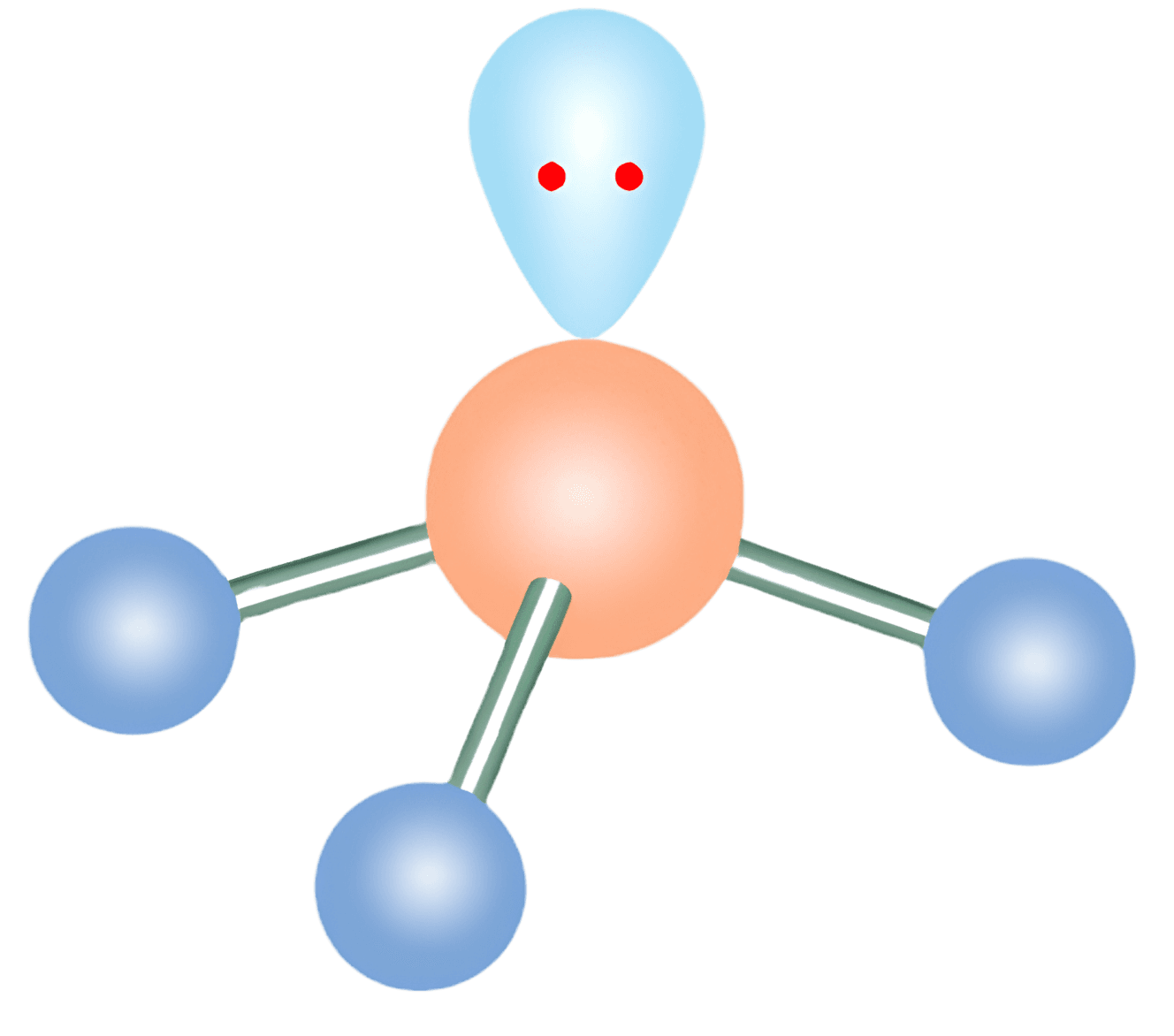 Trigonal pyramidal | Drawing 2026-08-24 19.58.06.excalidraw | remember | |
| 2/2 | 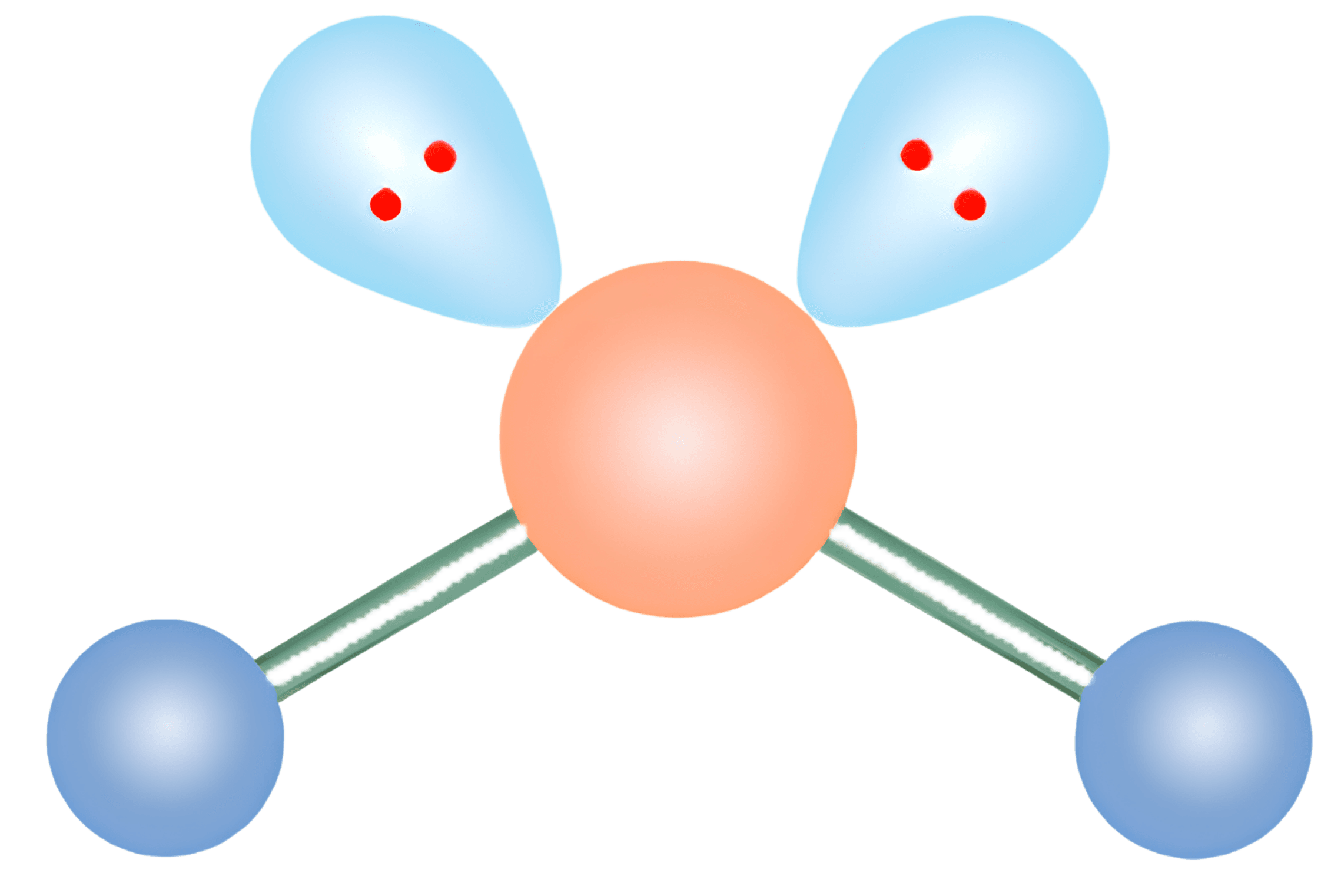 Bent or V-shaped | Drawing 2026-08-24 20.00.13.excalidraw | remember |
5 Electron Groups
| Chemical | No. of b.p./l.p. | Shape | Written as | Bond Angle |
|---|---|---|---|---|
| 4/1 | 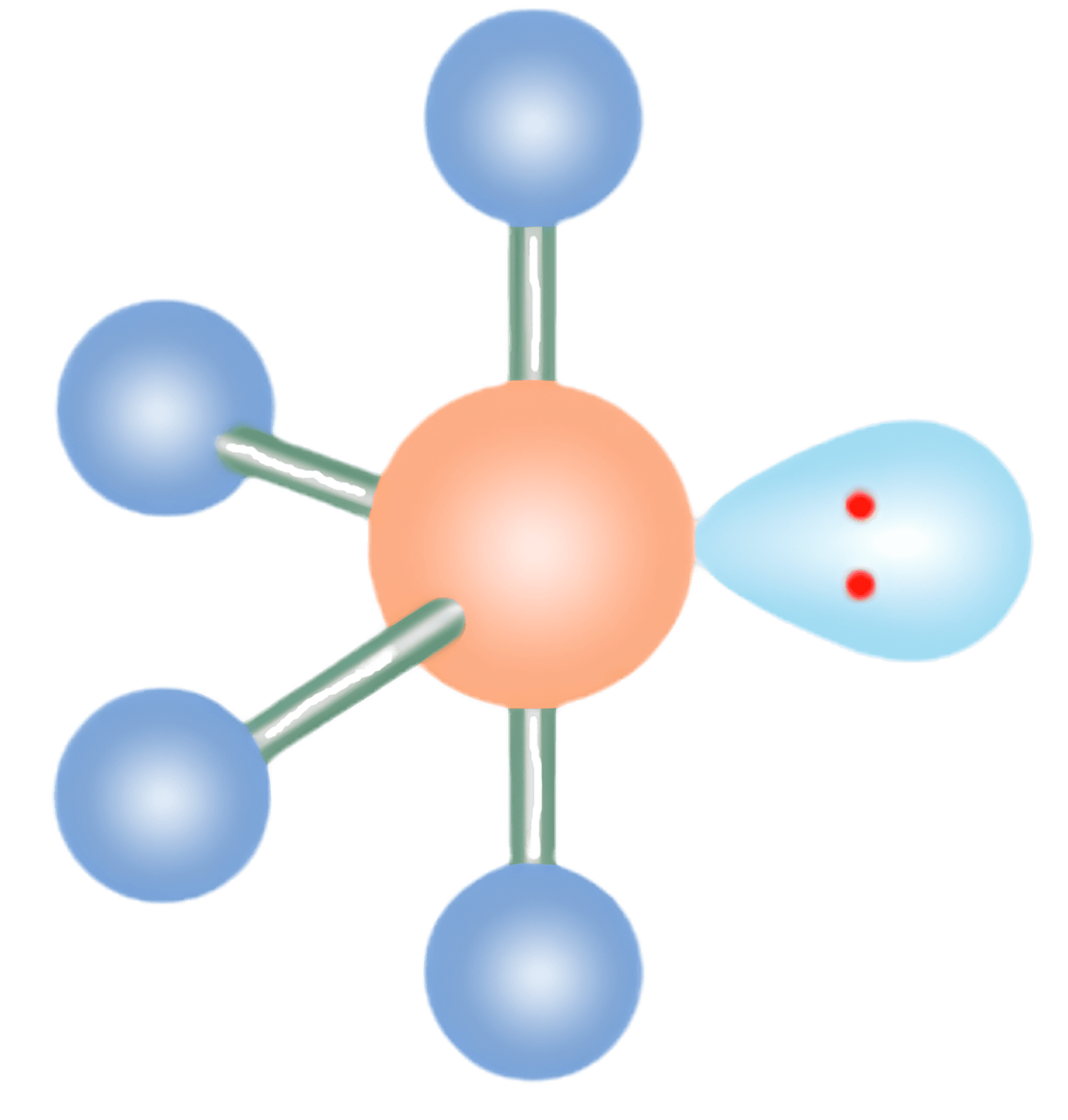 see-saw | Drawing 2026-08-24 20.01.46.excalidraw | ||
| 3/2 |  T-shaped | Drawing 2026-08-24 20.02.44.excalidraw | ||
| 2/3 | 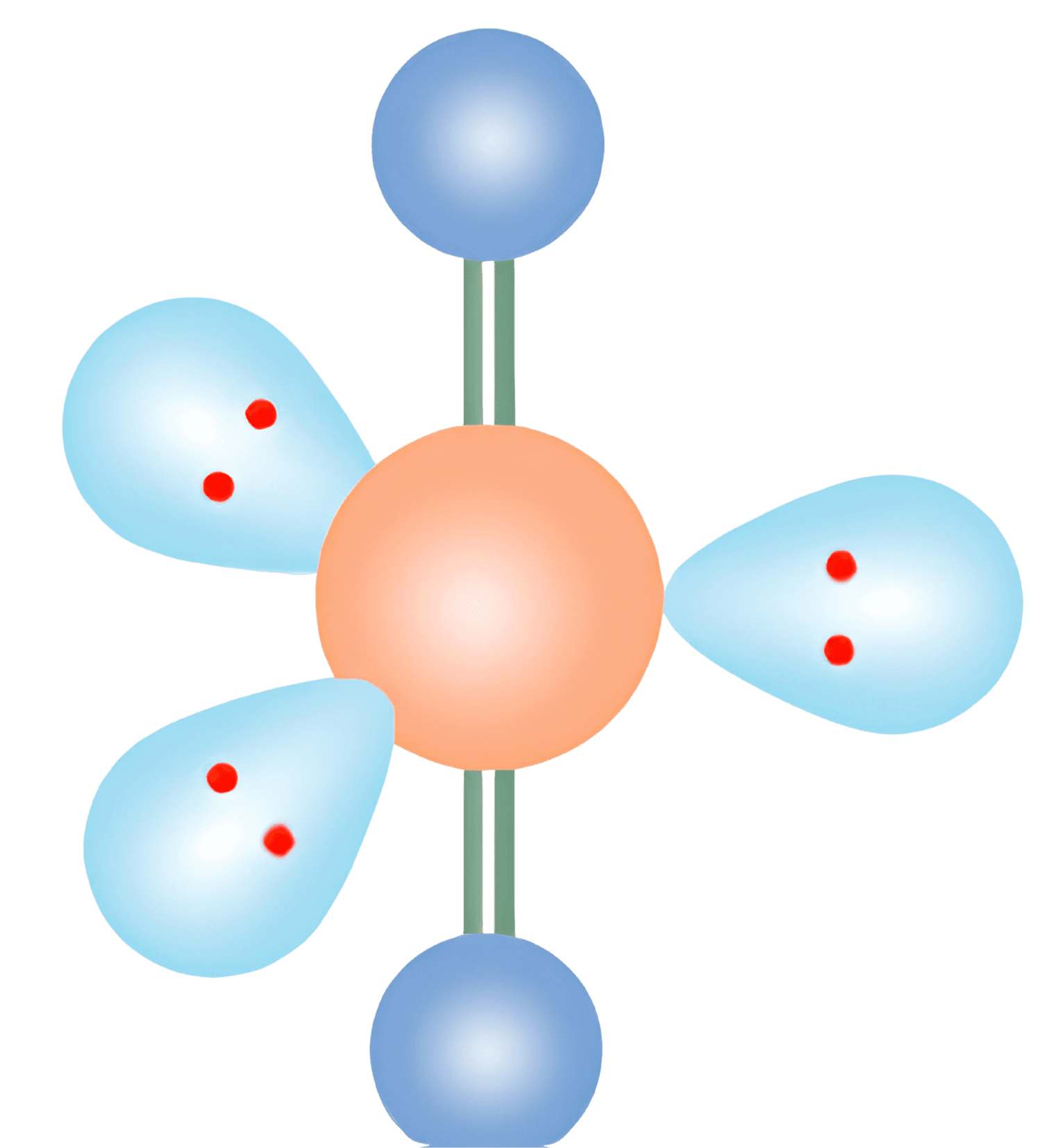 Linear | Drawing 2026-08-24 20.03.55.excalidraw |
6 Electron Groups
| Chemical | No. of b.p./l.p. | Shape | Written as | Bond Angle |
|---|---|---|---|---|
| 5/1 | 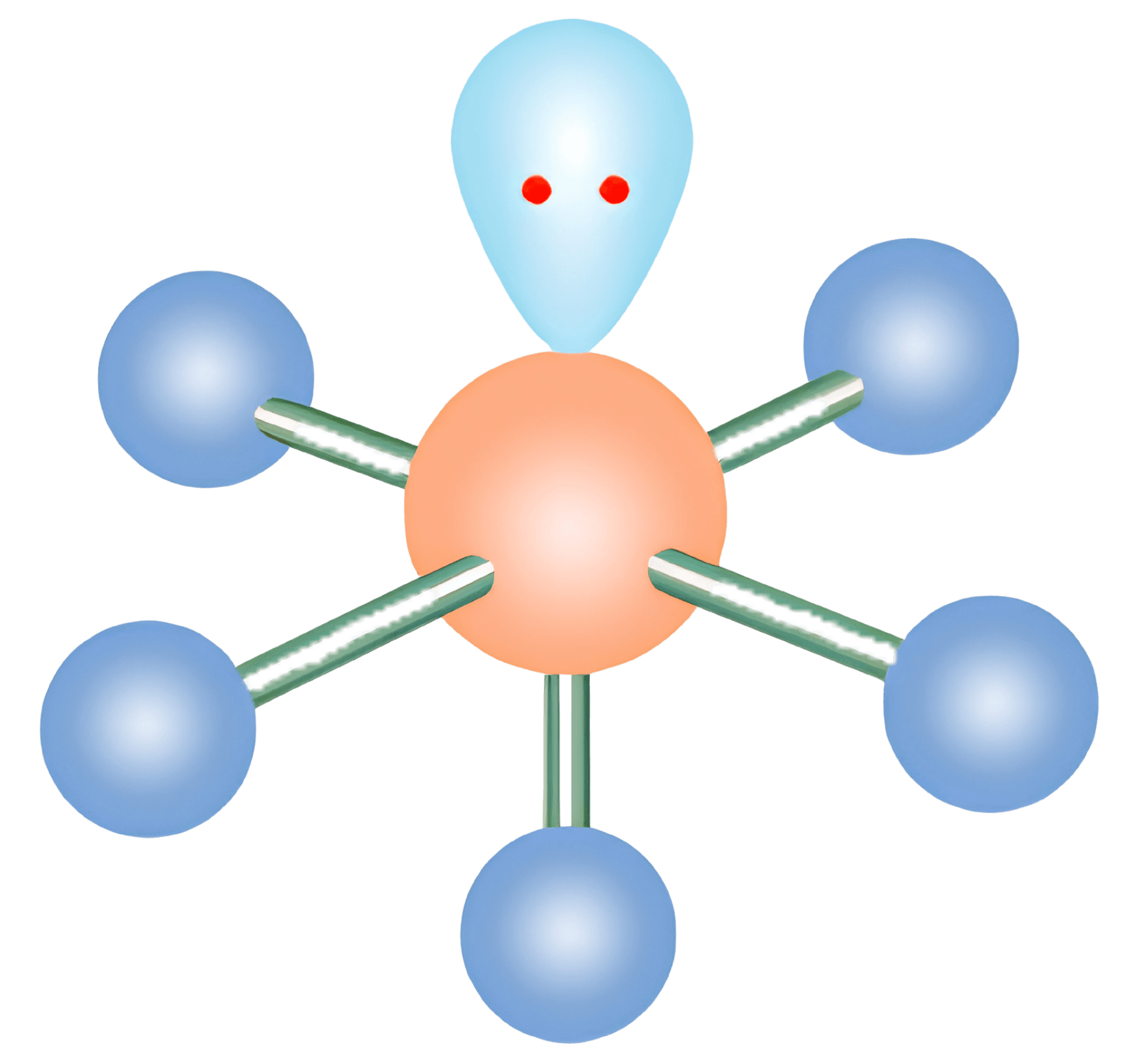 Square pyramidal (lone pair can be in any of the 6 positions) | Drawing 2026-08-24 20.05.23.excalidraw | ||
| 4/2 |  square planar (2 lone pairs must be opposite each other) | Drawing 2026-08-24 20.07.10.excalidraw |
Intermediate bonding #smtp
- Depending on the electronegativity of the atoms involved in bonding, intermediate bonds are formed
- They are covalent bonds with ionic character (polar covalent bonds) or ionic bonds with covalent character
Electronegativity
- The more electronegative atom has the greater tendency to attract the bonding electrons to itself
- This atom acquires a partial negative charge (labelled ) due the build up of electron density around it
- The other atom in the bond then acquires a partial positive charge (labelled )
Bond polarity in covalent bonds
- Bond polarity refers to a separation of positive and negative charge
- Non-polar bond refers to bonding where electrons are shared equally, e.g. ,
- Polar bond refers to bonding with unequal sharing of bonding electrons due to the differences in electronegativity of the bonding atoms, e.g.
- A polar bond has a dipole moment; The greater the difference in electronegativity the greater the bond polarity and the greater its dipole moment
- the concept of dipoles only apply to simple covalent molecules as ions are have a full net charge and cannot be said to be polar or non-polar
- A polar covalent bond is said to have partial ionic character
- If electronegativity difference is great enough, one atom can attract the bonded electron pair so much that electron transfer takes place and an ionic bond is formed
Non-polar molecules
- A non-polar molecule is one that has no overall dipole; reason being
- there is no polar bond in the molecule
- All atoms are the same, e.g.
- The bonds in hydrocarbons are considered as non-polar due to their similar electronegativity values OR
- There are polar bonds in the molecule but the dipole moments cancel out such that the overall dipole moment is zero, e.g.
- there is no polar bond in the molecule
Polar molecules
- A polar molecule has an overall permanent dipole, e.g.
- There must be at least one polar bond in the molecule
- The dipole moments of the polar bonds do not cancel out each other such that the net dipole moment is not zero
Examples
| Compound | Lewis structure with bond dipoles and net dipole moment | Polar/non-polar |
|---|---|---|
| Drawing 2026-09-14 23.37.33.excalidraw | non-polar | |
| Drawing 2026-09-14 23.42.19.excalidraw | polar and are taken as no delta charge as difference in electronegativity is very small | |
| Drawing 2026-09-14 23.45.52.excalidraw | non-polar |
Ionic bonds with covalent character
Polarisation of Ionic Bonds
- In an ideal ionic compound, electrostatic forces exist between oppositely charged ions that both have spherical electron clouds
- However, if the cation has high polarizing power, the attraction on the anion's electron cloud may be enough to distort it such that there is partial sharing of electrons from the anion
- The anion is said to be polarized
- The ionic bond is said to have partial covalent character
Charge Density
- The charge density of an ion is the ratio of its charge to its ionic radii
- Charge density decrease down a group
- For cations, a higher charge density corresponds to a higher polarizing power
- For anions, a larger ionic size leads to a higher polarizability
- Both anion size and polarizability increase down a group
Fajan's rules
- Bonding tends to be covalent is the charges on both cation and anion are large
- Bonding tends to be covalent if the cation is small and the anion is large
- Thus, if the cation ion is small and has a large charge, and the anion is large the cation will have high polarising power and the anion will have high polarizability the cation will be able to polarize the anion substantially, resulting in the overlap of electron cloud and covalent characteristics in the bonding
Covalent bonding
Covalent bonding is the electrostatic forces of attraction between the positively charged nucleus of both the bonded atoms and their shared pair of electrons. The covalent bond is formed by an overlap of valence atomic orbitals. The resultant electron cloud is called a molecular orbital.

Types of covalent bonds
- Sigma () bonds
- Pi () bonds
Sigma bonds
- Sigma bonds are formed by the 'head-on' overlap of two atomic orbitals.
- There can only be one sigma bond between two atoms as there is no other way for another head-on overlap of the atoms' orbitals to take place.
- e.g.
- Sigma bond formed between two -atomic orbitals

- Sigma bond formed between -atomic and -atomic orbitals

- Sigma bond formed between two -atomic orbitals

The distance of pi bonds

- When the atoms are too far apart, each behaves as though the other isn't present
- As the distance between the two decreases, each nucleus starts to attract the other atom's electron, lowering the overall potential energy of the system
- The attractions continue to draw the atoms closer and the system becomes progressively lower in energy.
- However, nucleus-electron attractions and nucleus-nucleus and electron-electron repulsion exist simultaneously.
- As distance decreases further, the repulsion between the nuclei and between the electrons of both atoms become significant.
- At some optimum inter-nuclear distance, the maximum attraction is achieved where the repulsive forces just balance the attractive forces. The system has its minimum energy at this point. A covalent bond is formed at this fixed distance.
- The bond length is the distance between the 2 nuclei when the covalent bond is formed.
- Any shorter distance will result in net repulsion and raises the overall energy of the system.
- One pair of electrons constitutes one covalent bond.
- The electron cloud that forms between the bonded atoms as a result of atomic orbitals overlapping is called a molecular orbital.
Pi bonds
bonds are formed by the 'side-on' overlap of two atomic orbitals. These atomic orbitals can only be p or d orbitals.

Single and multiple bonds
- Depending on the type and number of atomic orbitals involved, it is possible to have more than I covalent bond formed between 2 atoms.
- The bond order is the number of covalent bonds formed between 2 atoms
Hybrid orbitals

In the ethene () molecule, each carbon atom utilizes its three hybrid orbitals—each shaped like a lopsided dumbbell—to build the flat, foundational skeleton of the molecule. Because these three orbitals naturally repel one another, they spread out into a flat, trigonal planar arrangement, pointing outward to form the strong, head-on sigma () bonds with two hydrogen atoms and the adjacent carbon atom. Meanwhile, the single unhybridized orbital left over on each carbon stands perfectly vertical, completely perpendicular to this flat plane. These upright orbitals then reach across the gap to overlap sideways, creating the pi () bond that locks the two carbon atoms together into a rigid, non-rotating double bond.
Covalent Diagramms
- electron pair shared between two atoms is a bond pair; an electron pair that is part of a valence shell but not shared with another atom is a lone pair
Drawing Dot and cross
- Show all the valence electrons, including those valence electrons not involved in bonding.
- The element's symbol represents the nucleus and the inner shell electrons.
- Use only dots (O and crosses (x) to represent electrons. Do not use other symbols like circles, triangles or squares, unless otherwise stated.
- Between any two bonded atoms, use different electron symbols (but • and x only).
- When adding new electrons (through octet expansion), use different electron symbols
- Following the octet rule, compounds should be bonded such that it has eight elections in its valence shell.
Drawing Lewis structure
- While dot-and-cross diagrams show the distribution of valence electrons clearly, it is often troublesome to draw all the dots and crosses. Hence these dots and crosses are often abbreviated with lines and dots.
- The bond pair is represented by a line and the lone pair by dots,
- A single line () is used to indicate a single bond, two parallel lines () for double bonds and three parallel lines () for triple bonds.
- Lone pair of electrons on central atoms of a molecule are shown with dots
Examples
Molecules with single bonds
Molecules with multiple bonds
If terminal atoms still do not have an octet after forming a single bond, move the electrons on each atom about such that multiple bonds between the central and terminal atoms are obtained
Exceptions to the octet rule #smtp
Expansion of the Octet
Many molecules and ions have more than eight electrons around the central atom. Reason: The central atom (only from Period 3 and above) has available vacant -orbitals to accept electrons in forming covalent bonds.
| Compound | Dot-and-Cross Diagram | Lewis Structure |
|---|---|---|
| Drawing 2026-04-18 13.16.03.excalidraw | Drawing 2026-04-18 13.19.11.excalidraw | |
| Drawing 2026-04-18 17.34.33.excalidraw | Drawing 2026-04-18 17.36.46.excalidraw |
Electron deficient molecules
Electron deficient molecules have fewer than 8 electrons around the central atom; Peripheral atoms must still follow the octet rule.
Odd Electron Species
Some molecules contain an odd number of valence electrons, hence-they cannot possibly have all their electrons paired. Such species are called free radicals and are very reactive. Most odd electron species have a central atom carrying an odd number of valence electron such molecules usually have a Group 15 or Group 17 element as the central atom.
Dimerisation
Dimerization is a process where two identical molecules (monomers) join together to form a lager, more stable molecule (dimer). It address the instability of electron deficient molecules and odd electron species
- For Odd Electrons: Two radicals share their single electrons to form a new bond (e.g., ). Drawing 2026-04-18 13.09.57.excalidraw
- For Electron Deficiency: Atoms use dative bonding to share lone pairs from a neighbor (e.g., ). Drawing 2026-04-18 13.01.46.excalidraw
Dot and Cross of Polyatomic Ions
Consider the Electronegativity (EN) of atoms in the ion For each () charge, add one electron to the more electronegative atom. e.g. Flourine is assigned the extra electron instead of chlorine in . For each () charge, remove one electron from the less electronegative atom. e.g. the electron is removed from hydrogen instead of nitrogen in
Examples
| Compound | Dot-and-Cross Diagram | Remarks |
|---|---|---|
| Drawing 2026-04-18 17.49.40.excalidraw | Electron removed from Phosphorus | |
| Drawing 2026-04-18 17.52.57.excalidraw | Electron added to oxygen | |
| Drawing 2026-04-18 17.53.33.excalidraw | one electron added to each oxygen | |
| Drawing 2026-04-18 18.04.24.excalidraw | sulfar expanded octet; two electrons added to two oxygen | |
| Drawing 2026-04-18 18.09.24.excalidraw | electron added to each oxygen | |
| Drawing 2026-04-18 18.18.53.excalidraw | Drawing 2026-04-18 18.24.38.excalidraw Arrow is a diative bond, where a electron "gives" two electrons to another atom electron is given to the oxygen without diative bonds |
Species with diative bonds
when an atom donates a lone pair to another atom which has an empty or vacant orbital, a diaive or co-ordinate bond results. In a diative bond, both atoms in the bond pair come from one atom, however, once formed, dative bonds are identical to covalent bonds. The history of electrons does not matter once the bond exists, when the electrons become delocalised between the two atoms' nuclei. Drawing 2026-04-18 21.16.00.excalidraw
A diative bond in a lewis structure is denotated by donating atom receiving atom. Diative bonds usually form between an electron deficient species and a molecule with lone pair.
e.g. Boron trifluoride, and ammonia, , react to form an adduct, Drawing 2026-04-18 20.54.21.excalidraw
