02_Atomic Structure
- An atom is the smallest component of an element having the chemical properties of the element.
- All atoms are made up of the same three subatomic particles - electron, proton and neutron.
Properties of subatomic particles
| Particle | Charge / C | Mass / kg | Relative Charge | Relative Mass | Location |
|---|---|---|---|---|---|
| Proton | Nucleus | ||||
| Neutron | Nucleus | ||||
| Electron | Orbitals |
Nuclide Notation & Isotopes
| Symbol | Definition |
|---|---|
| Z | Atomic Number: Number of protons |
| A | Mass Number: Protons + Neutrons |
| X | Chemical Symbol: Element shorthand |
| term | Description |
|---|---|
| Isoelectronic | Atoms and ions that contain the same number of electrons |
| Isotonic | Atoms and ions that contain the same number of neutrons |
| Isotopic | Atoms and ions that contain the same number of protons |
| Isotopes | Atoms of the same element that have the same number of protons but different number of neutrons |
Relative atomic mass
- Relative Atomic Mass (): The weighted average of the relative isotopic masses of an element's naturally occurring isotopes.
- Must write out in full
Mass Spectrometry Data
- X-axis: Relative Isotopic Mass
- Y-axis: Relative Abundance (%)
- Interpretation: The value will always be numerically closest to the isotope with the highest peak (greatest abundance)

Deflection of beams in an electric field
Drawing 2026-03-09 00.03.47.excalidraw
- Protons are positively charged, hence attracted to negative electrodes (anode)
- Electrons are negatively charged, hence attracted to positive electrodes (cathode)
- Neutrons are neutral, hence not attracted to any charged electrodes
- Angle of deflection charge/mass ratio

Electronic Structure of Atoms
- Quantum number (n) describes the size and energy level of the orbital.
- Subshells: Each principal quantum shell is subdivided into one or more subshells.
- Orbitals: Each subshell (s, p, d, f, etc.) has one or more orbitals having the same energy but different orientations in space. An orbital is defined as the region of space where there is a 90% probability of finding an electron. Each orbital can hold up to 2 electrons.
- Spin: An electron may have a +½ or -½ spin.
| Principal quantum number, n | Subshell | Number of orbitals | Maximum number of electrons in each principal quantum shell |
|---|---|---|---|
| 1 | 1s | 1 | 2 |
| 2 | 2s 2p | 1 3 | 8 |
| 3 | 3s 3p 3d | 1 3 5 | 18 |
| 4 | 4s 4p 4d 4f | 1 3 5 7 | 32 |
Writing the Electronic Configuration
- Aufbau principle: electrons in their ground states occupy orbitals in order of increasing orbital energy level. The lowest energy orbitals are always filled first.
IMG-20260403230430328.png#invert

- Pauli Exclusion principle: an orbital cannot hold more than two electrons and the two electrons occupying the same orbital must have opposite spins. (E.g. and not or )
- Hund’s rule: the orbitals of a subshell must be occupied singly with parallel spins before they can be occupied in pairs.
Example
For atom, the electronic configuration is 1s² 2s² 2p⁴

Electronic Configuration
| Atomic Number | Name of the Element | Electronic Configuration | Electron-in-box representation |
|---|---|---|---|
| 1 | Hydrogen (H) | ||
| 4 | Beryllium (Be) | [He] | |
| 10 | Neon (Ne) | [He] | |
| 12 | Magnesium (Mg) | [Ne] | |
| 15 | Phosphorus (P) | [Ne] | |
| 20 | Calcium (Ca) | [Ar] | |
| 21 | Scandium (Sc) | [Ar] * | |
| 24 | Chromium (Cr) | [Ar] ** | |
| 27 | Cobalt (Co) | [Ar] | |
| 29 | Copper (Cu) | [Ar] ** | |
| 30 | Zinc (Zn) | [Ar] | |
| *The 4s orbital is lower in energy than 3d. Thus 4s orbital is filled before 3d orbital even though 4s is part of a shell whose average distance is further away from the nucleus | |||
| *In , is more stable than due to the former's symmetrical distribution |
shapes of orbitals
| Orbital | Shape | Notes |
|---|---|---|
| S | Drawing 2026-04-19 13.04.26.excalidraw | Each s subshell consists of 1 orbital Alls orbitals are spherical in shape The s orbital always has slightly lower energy than the p orbitals, so the's orbital always fills with electrons before the corresponding p orbitals do s subshells of different principal quantum shells, n, have the same shape but different size (15 < 25 < 3s <4s..) |
| P | Drawing 2026-03-09 21.52.27.excalidraw | Each p subshell consists of 3 p orbitals, namely , , All p orbitals have a dumbbell shape All 3 orbitals have the same size, shape and energy (degenerate), but have a different orientation in space. The , , orbitals are mutually perpendicular to each other. p orbitals of different quantum shells, n, have the same shape but different size (2p < 3p < 4p < 5p…) |
| D (not tested) | < | < |
| F (not tested) | < | < |
Periodic Trends #smtp
- Elements under the same group have the same number of valence electrons
- Elements in the same period have the same number of electron shells
| Property | Symbol | Description |
|---|---|---|
| Effective nuclear charge | Net nuclear charge experienced by an outer electron | |
| Nuclear charge | No. of protons in the nucleus | |
| Shielding constant | Inner shell electrons partly offset the positive charge of the nucleus, hence shielding the outer electron from the full charge of the nucleus An electron in the same valence shell, in this case the valence electronic shell, does contribute slightly to the shielding constant | |
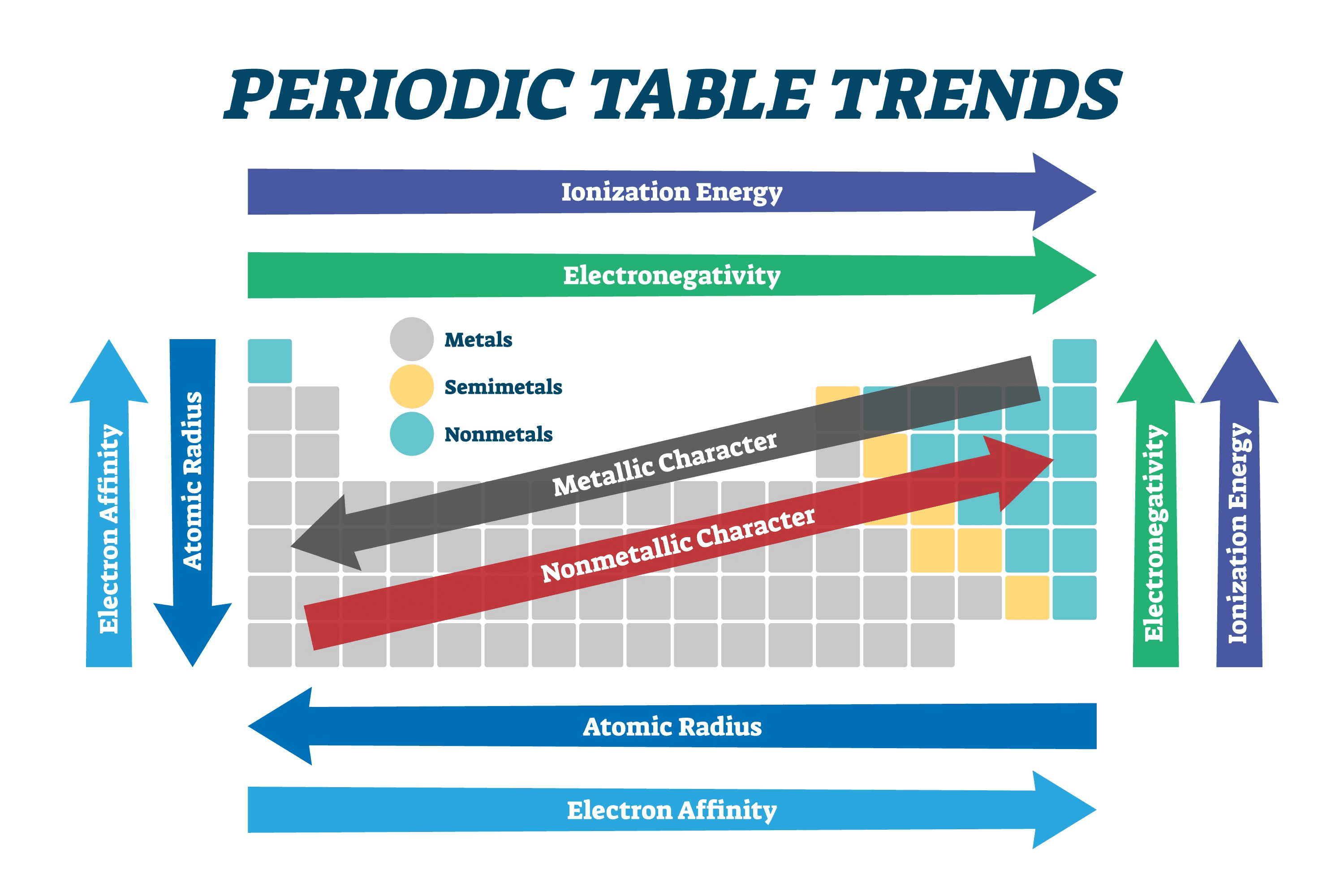 |
Ionization Energy (IE) Trends
- is defined as the amount of energy required to remove an electron after removing electrons
- is affected by distance from the nucleus and effective nuclear charge, which itself is affected by shielding constant ( from both inner electrons and valence electrons, to a smaller extent)
- generally, as the charge of an element increases, increases
First Ionization Energy ( IE)

- Down a Group (Decreases): Atomic radius increases due to more quantum shells. This results in weaker electrostatic attraction between the nucleus and the outermost electron, requiring less energy for removal.
- As elements in the same group have equal valence electrons, the shielding constant roughly cancels out the difference in nuclear charge. Thus the main driver of difference is distance from nucleus. Elements down a group will have their valence electrons further away from the nucleus, reducing the pull on valence electrons and the 1st
- Exceptions ;(
- Scandide Contraction
- Although Gallium () is in a lower period than Aluminium (), Gallium has a slightly higer than Aluminium. The reason for this is between Magnesium () and Aluminium, only one proton is added, whereas between Calcium () and Gallium, there is an entire block of transition metals, causing Gallium to have 10 extra protons. The 10 extra electrons go into the -orbital, which owing to its shape, is extremely poor at sheilding. Therefore the electrons fail to adequately block the charge, causing the valence electrons to be more attracted to the nucleus and making Gallium have a higher .
- Lanthanide Contraction
- Going down in period from Silver () to Gold (), IE increases significantly. Reason is that before getting to Gold, there is the Lanthanides (-block elements), adding 14 extra protons. The 14 extra electrons are added to the -block, which are practically non-existent in terms of shielding (significantly worse than -block). They're orbitals are large, diffuse, and provide almost zero shielding for the outer electrons. Thus, Gold's outer electron feel an overwhelming amount , till its atomic radii is smaller than Silver, despite increased atomic number.
- Scandide Contraction
- Across a Period (Increases): Generally increases due to increasing , due to increasing effective nuclear charge. This is due to fractional increase () of the shielding constant not being enough to offset the increase () of the nuclear charge
- e.g. going from to ; However there are exceptions
- Jumping subshell: When jumping from and subshell to a subshell, generally decreases slightly as the subshell is further away from the nucleus that the subshell, shielding also slightly increases
- e.g. going from to , decreasing from
- exceptions include when going from a element to a element, this is due to the extra proton that increase nuclear charge. The extra electron in the subshell does not contribute enough to the shielding constant offset the increased nuclear charge, leading to the electrons being pulled in closer and increasing
- Electron repulsion: Stability and energy are inversely related; unpaired electrons are more stable; Electrons that exist at higher energy levels tend to be further away from the nucleus;
- e.g. () and (), Sulfur has a lower 1st , as it is has more paired electrons (1 more), meaning its less stable, meaning it exists at a higher energy level, meaning its going to be further away from the nucleus, therefore, it has a lower , compared to
- other phrasing: Forcing two negatively charged electrons into the same region of space (the same orbital) creates a significant amount of localised electrostatic repulsion (they are pushing away each other quite strongly), causing decrease in attraction to nucleus
- Entering a new period significantly decreases first
- e.g. Helium (): The two electrons are in the same shell (). Electrons in the same shell do not shield each other very well. Because the shielding is weak, the valence electrons feel almost the full attractive force of the 2 protons in the nucleus. Thus, is very high. Lithium (): As you noted, those electrons are now inner core electrons. Core electrons are incredibly effective at shielding the outer valence electrons from the nucleus. Because of this strong shielding, the single valence electron feels a significantly lower than the electrons in Helium, making it easier to pull away. Additionally, In Helium, you are removing an electron from the shell, which is right next to the nucleus. In Lithium, you are removing an electron from the shell. the increased distance contributes significantly to reduced first IE
- Priority between lowest period and highest group varies
- Only way to determine is comparing numbers
Successive Ionization Energies
- For a single element, IE always increases (IE_1 < IE_2 < IE_3...)
- where refers to amount of energy required to remove on more electron
- While the number of protons remains the same, removing an electron reduces mutual electrostatic repulsion (shielding) among the remaining outer electrons
- increases, requiring more energy to remove subsequent electrons from an increasingly positive ion
- Determining Group Number: A massive jump in successive IE values implies that the next electron is being removed from an inner quantum shell, which reveals the number of valence electrons (and thus the Group number)
- e.g. If the first major IE spike is between the 2nd and 3rd IE, it can be inferred that the element is in group 2
| Rank (Energy Filling Order) | Subshell | Principal Shell () | Subshell Type | Penetration Ability / Closeness to Nucleus | Ease of Removal (Ionization) |
|---|---|---|---|---|---|
| 1 | 1s | 1 | Maximum. Closest to the nucleus. | Hardest to remove | |
| 2 | 2s | 2 | High penetration. | Very hard | |
| 3 | 2p | 2 | Moderate penetration. Shielded by 2s. | Hard | |
| 4 | 3s | 3 | High penetration within shell 3. | Moderate | |
| 5 | 3p | 3 | Moderate penetration. Shielded by 3s. | Easier | |
| 6 | 4s | 4 | Penetrates so deeply it drops below 3d in energy. | Varies (Removed before 3d) | |
| 7 | 3d | 3 | Poor penetration. Highly shielded. | Easier | |
| 8 | 4p | 4 | Moderate penetration within shell 4. | Very easy | |
| 9 | 5s | 5 | High penetration within shell 5. | Very easy | |
| 10 | 4d | 4 | Poor penetration. | Extremely easy | |
| 11 | 4f | 4 | Minimum. Almost no penetration. | Easiest to remove |
- Note: While 4s fills before 3d because it penetrates closer to the nucleus, once the 3d subshell has electrons in it, they repel the 4s electrons outward, reducing the 1st IE required.
- This is also why 4s electrons are first to be removed when transition metals form ions
- Note: Change in (subshell) incrementally bumps IE, while change in (principal shell) significantly increases IE
Atomic Radii Trends
The physical distance from the nucleus to the outer boundary of the electron cloud.
- Atomic radii down a group: increases
- New, higher-energy principal quantum shells () are added. These new shells are physically further from the nucleus.
- Furthermore, as the increase in increases more than , decreases, resulting in the nucleus exerting a weaker hold/pull on its valence electrons
- Atomic radii across a period: decreases
- Effective nuclear charge () increases as protons are added without new inner-shell shielding. This stronger nucleus pulls the entire electron cloud in tighter.
Exceptions
- The d-block Contraction (Scandide Contraction): Occurs in Group 13 (e.g., Al vs. Ga). The extremely poor shielding provided by the newly added electrons causes to increase rapidly, making atoms like Gallium unexpectedly smaller than the element above them.
- The Lanthanide Contraction: Occurs in Period 6 (e.g., Ag vs. Au). The massive, diffuse orbitals provide almost zero shielding against the 14 newly added protons, creating an overwhelming nuclear pull that keeps these heavy atoms incredibly compact.
Ionic Radii of cations and anions

- Isoelectronic Ions: Ions with the same number of electrons (e.g., all have 10 electrons; all have 18 electrons)
- These ions are all part of an isoelectronic series
- An isoelectronic series is group of molecules, atoms or ions that share the same number of electrons, and consequently the same electronic configuration
- Generally, in an isoelectronic series, Lowest Proton Number = Weakest Pull = Largest atomic radii
- increases, as nuclear charge increase while shielding remains constant, strengthening attraction between the nucleus and valence electrons, thus decreasing ionic size
- Cations vs. Anions: There is a sharp increase in radius when moving from a cationic series to an anionic series because anions possess one more quantum shell of electrons than the cations
Electronegativity ^93ef49
Electronegativity is the relative ability of an atom in a molecule to attract the shared electrons in a covalent bond
- Across a Period (Left to Right): Increases
- A higher and a physically smaller atomic radius mean the nucleus can exert a much stronger electrostatic pull on any electrons it is sharing with a neighbouring atom.
- Down a Group (Top to Bottom): Decreases
- The atomic radius expands. Because the shared valence electrons are physically further away from the nucleus, the nucleus cannot pull on them as effectively.
Exceptions
- The Noble Gas Exception: Electronegativity is generally for most noble gases. Because they already have full valence shells, they do not naturally form chemical bonds, meaning there are no "shared" electrons to measure.
- The Post-Transition Metal Effect: EN unexpectedly increases slightly from Period 3 to Period 4 in the p-block (e.g., Al to Ga). This is a direct result of the d-block contraction; the unexpectedly small radius and poor -orbital shielding allow the nucleus to pull on shared electrons more strongly.
Electron Affinity
The energy change (typically released) when a neutral atom gains an extra electron. A more negative value means a higher affinity/desire for the electron.
- Across a Period (Left to Right): Increases (becomes more negative)
- Nonmetals on the right have a very high and are extremely close to achieving a stable, full valence shell. They release a large amount of energy when they finally capture that missing electron.
- Down a Group (Top to Bottom): Decreases (becomes less negative)
- As the atomic radius increases, the incoming electron is placed in a shell much further from the nucleus. This weaker electrostatic attraction results in less energy being released upon binding.
Exceptions
- The Group 2 Anomaly: These elements already have a perfectly stable, full subshell (). Adding an electron forces it into a new, higher-energy subshell, which actually requires energy input rather than releasing it (positive EA).
- The Group 15 Anomaly: These elements possess a stable, exactly half-filled subshell (e.g., Nitrogen's ). Forcing an extra electron into this subshell requires it to pair up, creating spin-pairing repulsion that significantly lowers the energy released.
- The Period 2 vs. Period 3 Anomaly (e.g., F vs. Cl): Period 2 atoms like Fluorine are so incredibly small that cramming an extra electron into the tight orbital causes severe electron-electron repulsion. Larger Period 3 atoms like Chlorine have more space in their orbitals, minimizing this repulsion and releasing more energy.
- The Noble Gas Anomaly: They already possess completely full valence shells (). Forcing an electron onto a noble gas requires placing it into an entirely new principal quantum shell, requiring a massive input of energy (highly positive EA).
